

Choosing between a high-deductible health plan and a PPO is the decision that trips up most people during open enrollment, because both options look reasonable on paper until you account for how you actually use healthcare. An HDHP lowers your monthly paycheck deduction but requires you to cover more costs out of pocket before insurance kicks in; a PPO costs more each month but gives you more predictable costs when you need care. This guide walks through exactly how the HDHP vs. PPO comparison works, when each plan makes financial sense, and how to run the numbers for your own situation before the enrollment window closes.
HDHP vs. PPO: The Core Trade-Off Explained
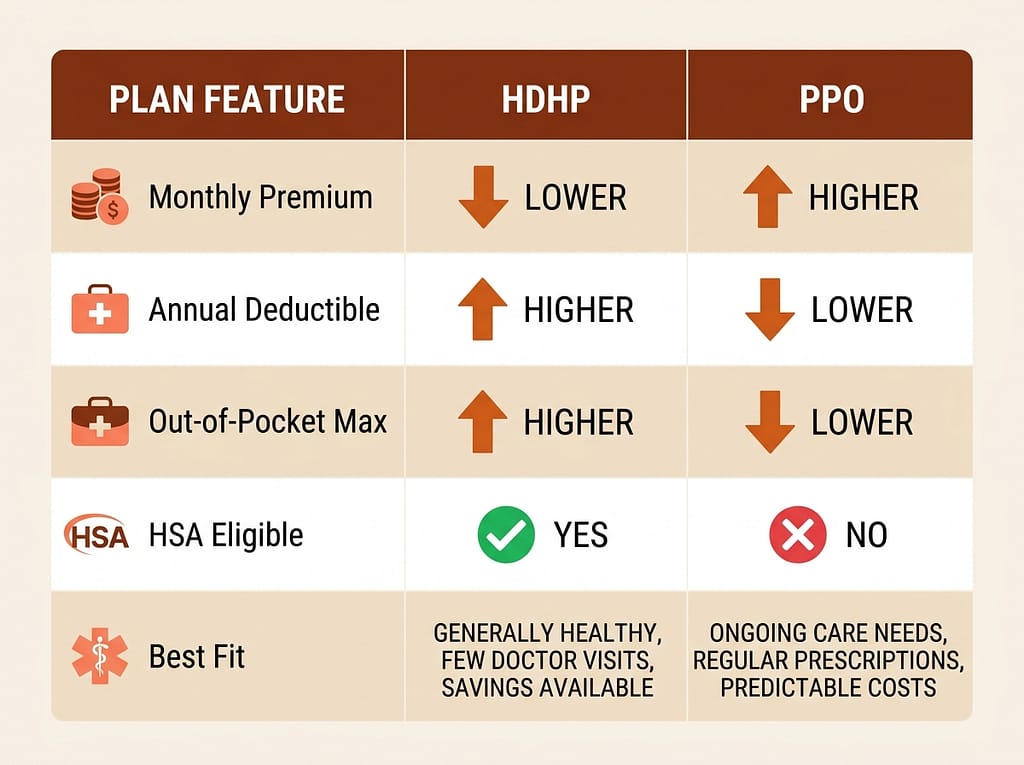
The fundamental difference between these two plans is the premium-versus-deductible trade-off. With an HDHP, or high-deductible health plan, you pay a lower monthly premium (the amount withheld from your paycheck for coverage), but your deductible, the amount you owe before insurance starts covering costs, is significantly higher. With a PPO, or Preferred Provider Organization, you pay a higher monthly premium, but your deductible is lower and your out-of-pocket costs when you actually need care are more predictable.
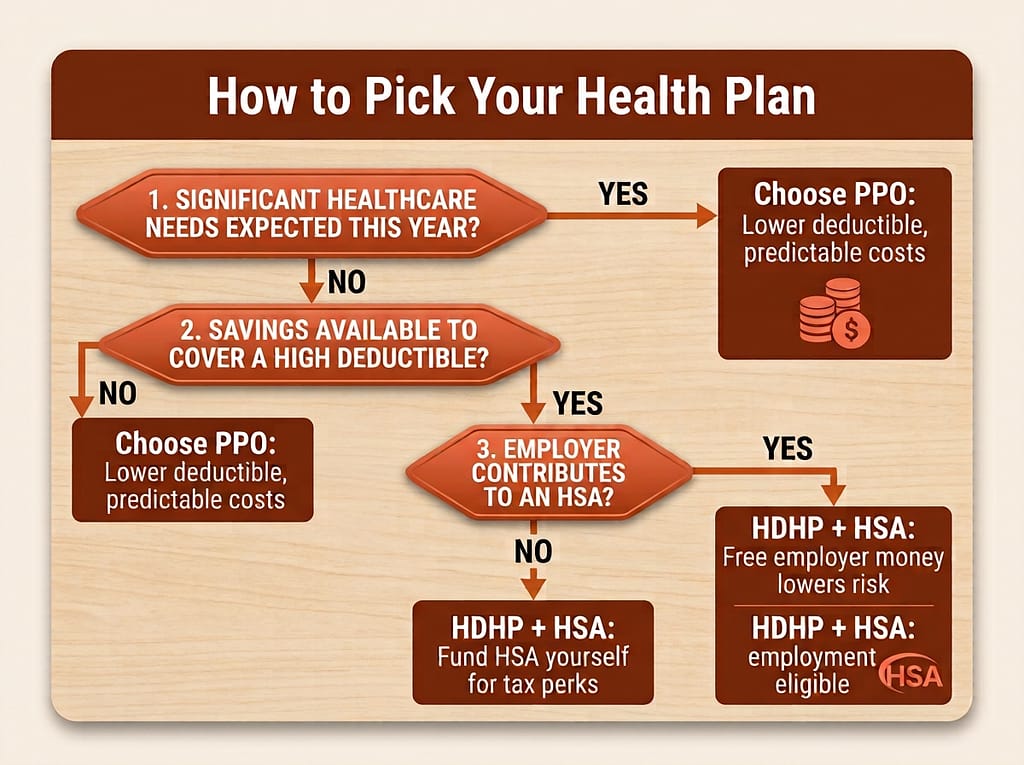
Neither plan is universally the better choice. The right option depends on how often you expect to use healthcare in the year ahead, how much savings you have available to cover a higher deductible if something unexpected happens, and whether your employer contributes to an HSA alongside the HDHP.
A number that often gets overlooked in the HDHP vs. PPO comparison is the out-of-pocket maximum: the most you will ever owe in a plan year before insurance covers 100 percent of costs. This ceiling protects you in a worst-case medical year and can make a high-deductible plan far less risky than it initially appears.
What Is a High-Deductible Health Plan (HDHP) and Who It Works For
An HDHP is defined each year by the IRS based on minimum deductible thresholds and out-of-pocket maximums. The distinguishing feature is a higher annual deductible paired with a lower monthly premium, often significantly lower than what a PPO costs. The additional benefit unique to an HDHP is eligibility to open a Health Savings Account (HSA), which lets you set aside pre-tax money to pay for medical expenses; those funds roll over year after year and never expire.
An HDHP tends to work well if you are generally healthy, had few doctor visits and no major prescriptions last year, and have savings available that could realistically cover the deductible if you needed care unexpectedly. When you pair an HDHP with consistent HSA contributions, the monthly premium savings can offset the higher deductible over time, especially if your employer also contributes to employee HSAs.
The HSA Connection: Why It Changes the HDHP Math
When you pair an HDHP with an HSA, contributions go in pre-tax, growth is tax-free, and withdrawals for qualified medical expenses are also tax-free. For 2027, the IRS contribution limit is $4,500 for self-only coverage and $9,000 for family coverage. Some employers contribute directly to employees’ HSAs as well, which is effectively free money toward your deductible.
What Is a PPO and When the Higher Premium Is Worth It
A PPO charges a higher monthly premium but delivers lower deductibles, lower copays at in-network providers, and more predictable costs when you use care. Most PPOs also allow you to see out-of-network providers without a referral, though at a higher cost. For someone with ongoing prescriptions, regular specialist visits, or a planned procedure in the year ahead, that predictability carries real financial value.
A PPO also tends to make more sense if you are not yet in a position to cover a high deductible out of pocket if something happened in the first few months of the plan year. The lower month-to-month uncertainty of a PPO can function as financial protection during a period when your savings cushion is still building.
HDHP vs. PPO: How to Run the Numbers for Your Situation
The most useful calculation when comparing plans is not “which premium is lower.” The better question is: what is your total cost in a typical year, and what is it in a bad year? To run this comparison, take the HDHP premium for the year and add your estimated out-of-pocket costs. Then do the same for the PPO. The plan with the lower combined number wins for a typical year.
For a bad year, meaning a year when something unexpected goes wrong, run the same math using each plan’s out-of-pocket maximum instead of your estimated costs. If the HDHP’s worst-case total is still lower than the PPO’s worst-case total, and you have the savings to cover the HDHP deductible if it comes, the high-deductible plan may protect you better on both ends.
The calculation shifts if your employer contributes to your HSA. Add any employer HSA contribution to your HDHP side of the math, since it reduces the amount of risk you are carrying.
Staying on a Parent’s Plan vs. Enrolling in Your Employer’s HDHP or PPO
Federal law allows you to stay on a parent’s health plan until age 26, even if your employer offers coverage. That does not automatically make it the right financial call. Compare the actual premium, deductible, network, and prescription coverage on both options before deciding.
A few questions to answer before you assume staying on a parent’s plan is cheaper: Does the parent’s plan cover providers in your area or near your workplace? Are you paying any portion of the family premium? What is the deductible compared to your employer’s plan? Staying on a parent’s plan can make sense in some situations and cost more in others. Let the comparison, not the path of least resistance, drive the decision.
How to Match Your HDHP or PPO Choice to the Year Ahead
Start with what you actually spent on healthcare last year. Pull together medical bills, pharmacy receipts, dental costs, and vision expenses. That number is a far more reliable input than any estimate.
Next, be honest about your savings cushion. An HDHP only makes financial sense if you could realistically cover the deductible out of pocket without serious strain. If you are still building an emergency fund, a PPO’s more predictable costs may protect you better this year, even at the higher monthly premium.
Finally, factor in any employer HSA contribution. If your employer puts money into your HSA when you elect an HDHP, that reduces your effective exposure under the high-deductible plan and should weigh into the comparison.
If you want a second opinion on these numbers before your enrollment window closes, a RedSky Money coach can work through the HDHP versus PPO comparison with you using your actual income, spending, and savings. Book a free Discovery Call.
Conclusion
The HDHP vs. PPO decision is not about which plan is better overall. It is about which plan fits your specific healthcare use, financial cushion, and how your employer structures the benefits around each option. A lower premium can free up real money every month, but only if you are prepared to handle the higher deductible when care happens. A PPO’s predictability carries genuine value, too, especially in years when your healthcare needs are hard to forecast. Run the actual numbers before you decide, and resist the temptation to choose based on what your coworkers picked.
Ready to find the right health plan for your budget?
Picking between an HDHP and a PPO is a numbers decision, not a gut-feel one. A free Discovery Call with a RedSky Money coach can help you run the comparison against your actual income, expenses, and savings before your open enrollment deadline arrives.
RedSky Money is a nonprofit. Our coaches are CFPs and AFCs, we sell no products, and coaching is always free.