

Open enrollment is the one window each year when you can sign up for, change, or drop your workplace benefits, including health insurance, HSAs, FSAs, life insurance, and disability coverage, without needing a life-changing event to qualify. Miss the deadline and you are locked into whatever you are currently enrolled in for up to twelve months, whether that plan still fits your situation or not. This guide covers how open enrollment works, what you are actually choosing between, the most common and costly mistakes people make, and a practical three-step checklist to get through the process before the window closes.
How Open Enrollment Works and Why the Window Is Short
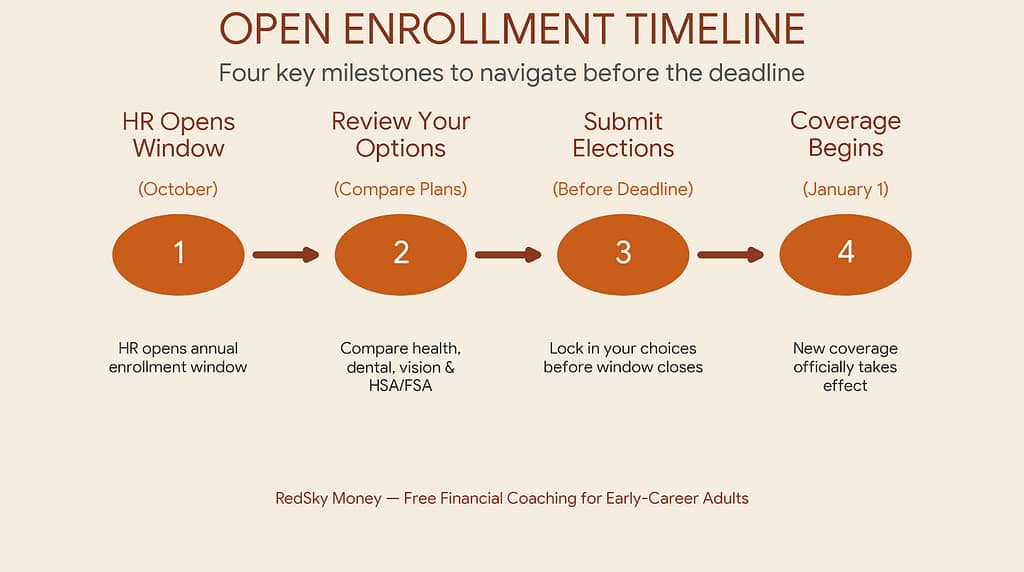
Open enrollment is a fixed annual period, typically in the fall, when your employer allows you to make changes to your workplace benefits. Most employers run their window between October and December, with new elections taking effect on January 1. The exact timing depends on your company, so check your HR portal early rather than waiting for a reminder email that might show up with only a few days left on the clock.
The reason open enrollment happens only once a year comes down to how insurance pricing works. Risk is spread across a large group of people over a predictable plan period, and if employees could switch plans every time a medical bill arrived, carriers could not price coverage accurately. That would push premiums higher for everyone. The annual window keeps the system stable and predictable, which is exactly why the deadline is firm and why skipping the process is one of the more expensive mistakes a young professional can make.
According to a 2026 survey from Selerix, only about one in four employees say they truly understand their workplace benefits, and 35 percent report regretting the choices they made during their last open enrollment period.
Why the Enrollment Portal Looks Harder Than It Is
The mechanics of how open enrollment works are straightforward once you know the sequence. You log into your employer’s benefits portal, review your current elections, compare available plan options, and submit your choices before the deadline. Most portals walk you through each decision in order.
The issue is that the portal assumes you already understand what you are looking at. Deductibles, out-of-pocket maximums, and benefit tiers look like data when what they actually are is a set of trade-offs that connect directly to your paycheck and savings. Once you understand the vocabulary, the decisions get manageable fast.
What Benefits You Can Change During Open Enrollment
Open enrollment is not just a health insurance decision. Depending on your employer, you may be selecting from a full menu of benefits, and each one affects your paycheck and your financial safety net differently.
Health, dental, and vision insurance are what most people focus on first. Health coverage handles medical care. Dental typically covers checkups and procedures. Vision usually covers eye exams, glasses, and contacts. Many employers bundle dental and vision as low-cost add-ons, so it is worth comparing the monthly premium against what you would actually spend out of pocket if you skipped it.
Beyond health coverage, you may also be deciding whether to open a Health Savings Account (HSA) or Flexible Spending Account (FSA), and how much to contribute to each. Both let you set aside pre-tax money for medical expenses, which lowers your taxable income and stretches your healthcare budget.
Life insurance and disability coverage are easy to overlook because they feel abstract when you are healthy. Basic life insurance is often available through employers at no cost or very low cost. Short-term and long-term disability coverage replaces part of your income if you cannot work due to illness or injury, which makes it worth reviewing, especially early in your career when your savings buffer is still building.
What Happens If You Miss the Open Enrollment Deadline
If the deadline passes and you do not have a qualifying life event, you are generally stuck with whatever you were enrolled in, or with no coverage at all if you were a new hire who never enrolled, until the next open enrollment cycle. That can mean up to a full year paying for a plan that no longer fits your needs.
Some employers automatically re-enroll you in your prior year’s coverage if you take no action. Others require active enrollment every year and leave you without benefits if you miss the deadline. Do not assume you know which approach your employer uses. Confirm with HR at the start of each enrollment period so there is no surprise.
Qualifying Life Events: When You Can Change Benefits Mid-Year
There is one meaningful exception to the once-a-year rule: a qualifying life event. Getting married, having a child, losing coverage under another plan, or moving to a new state can open a special enrollment window outside of the normal schedule. Depending on your plan, that window is typically 30 to 60 days from the date the event occurred.
Contact your HR department as soon as a qualifying event happens. Waiting even a couple of weeks can mean missing the special enrollment window entirely, and once it closes, you are back to waiting for the next annual open enrollment period.
Common Open Enrollment Mistakes That Cost You Real Money
Auto-renewing without reviewing what changed. Plans update every year, sometimes significantly, even when the plan name stays the same. Premiums shift, networks narrow, and deductibles change. Letting your coverage auto-renew without checking what changed is one of the most common ways people end up with a plan that no longer fits and costs more than it should.
Choosing a health plan based only on the monthly premium. A lower premium often comes with a higher deductible, so if you need care, you can pay significantly more out of pocket than a slightly higher monthly plan would have cost. The premium is one data point, not the whole picture.
Leaving free money on the table. Some employers offer an HSA contribution match or other benefit perks that go unused simply because employees do not know they exist. Reviewing your complete benefits guide, not just the health insurance section, can surface money that is already budgeted for you.
The most expensive open enrollment decision is not the wrong plan choice. It is skipping the process entirely and letting your coverage default to last year’s elections without checking whether any of them still make sense.
Your Open Enrollment Checklist: Three Steps Before You Click Submit
Step 1: Pull last year’s actual healthcare costs. Before you open the enrollment portal, gather what you actually spent on doctor visits, prescriptions, dental work, and vision care in the past twelve months. That number replaces guesswork with real data when you are comparing plan options.
Step 2: Gather dependent information and locate your portal login ahead of time. If you are adding a spouse, partner, or child to your plan, you will need their date of birth and Social Security number ready to enter. Find your HR portal login now so a forgotten password does not eat into your decision window.
Step 3: Write specific questions before contacting HR. HR teams are far more responsive earlier in the enrollment period than in the final 48 hours before the deadline. Prepare your questions about plan networks, waiting periods, and HSA contribution rules before the window opens, so you can get clear answers while there is still time to use them.
If you want a second set of eyes on your specific elections before you submit, a free coaching conversation is a low-pressure way to get clarity. A RedSky Money coach can look at your health costs, your savings buffer, and your budget alongside you, without selling you anything or steering you toward a specific provider. Book a free Discovery Call.

Conclusion
Open enrollment is not complicated once you understand the basic structure: a fixed window, a firm deadline, and a set of choices that will follow you for the next twelve months. The most expensive move is not the wrong plan choice. It is skipping the process entirely and letting your coverage renew automatically without checking whether any of it still fits. A few hours of attention during the enrollment window can save you hundreds of dollars over the plan year, and knowing what you are looking at before you log in makes those hours far less stressful.
Ready to make the most of open enrollment?
Open enrollment decisions carry more financial weight than most people expect. A free Discovery Call with a RedSky Money coach gives you a knowledgeable second opinion on your benefits elections before the window closes, with nothing to sell and no judgment on the choices you have already made.
RedSky Money is a nonprofit. Our coaches are CFPs and AFCs, we sell no products, and coaching is always free.