
Most employees with access to a retirement plan at work participate in it; many simply never start, often because the enrollment steps felt confusing or the deadline passed before a decision got made. Your 401(k) employer match is genuine additional compensation: money your employer deposits into your retirement account based on what you contribute from your own paycheck. This guide covers how to make the most of your 401(k) employer match at work, what Roth vs. traditional contributions mean for your taxes, and what a vesting schedule could cost you if you change jobs at the wrong time.

What Is a 401(k) Employer Match and Why Does It Matter?
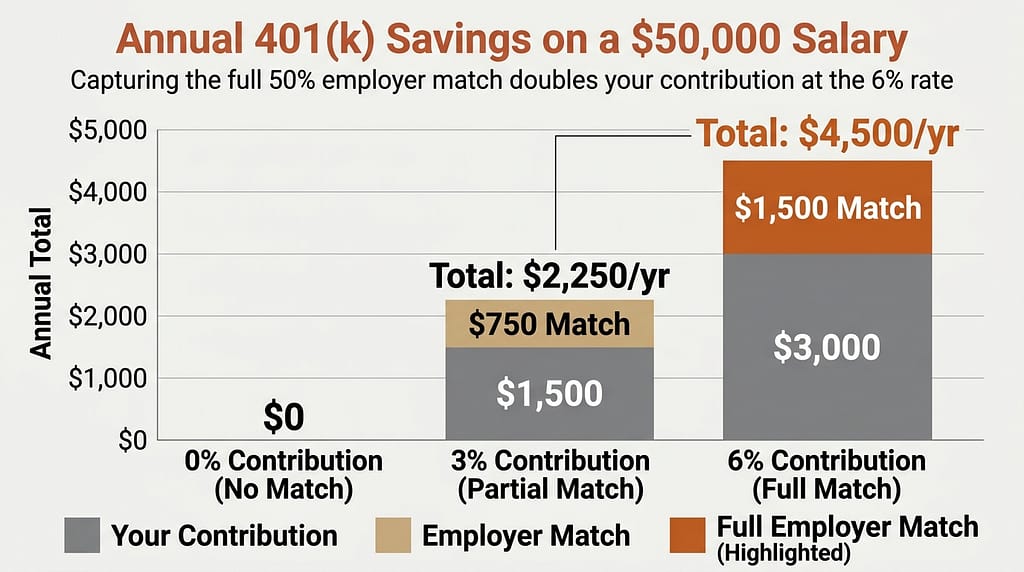
A 401(k) employer match is money your employer adds to your retirement account based on your own contributions. A common formula is a 50 percent match on contributions up to 6 percent of your salary. On a $50,000 salary, that looks like this:
- Your contribution at 6 percent: $3,000
- Employer match at 50 percent of your contribution: $1,500
- Total added to your retirement account this year: $4,500
That $1,500 is additional compensation that does not appear in your paycheck. If you contribute less than the percentage your employer will match, you are leaving a portion of your total pay unclaimed. This is the most direct financial case for capturing the full 401(k) employer match before any other financial priority.
As of March 2025, 72 percent of private industry workers had access to a retirement plan through their employer, yet only 53 percent actually participated. That gap represents a significant amount of uncaptured employer match and forgone compounding over time. (Source: U.S. Bureau of Labor Statistics, March 2025)
Your employer’s specific match formula is in your benefits documentation or HR portal. Match structures vary: some employers offer dollar-for-dollar matches; others offer partial matches like the 50 percent example above. Know your formula before you set your contribution rate.
How Much Should You Contribute?
The immediate target is straightforward: contribute at least enough to capture your full employer match. If your employer matches 50 percent of contributions up to 6 percent of salary, you should contribute at least 6 percent. Contributing less is the equivalent of turning down part of your compensation package.
The 2026 IRS employee contribution limit for a 401(k) is $24,500 (Source: IRS). Early actuarial projections suggest this figure may rise to approximately $25,000 for 2027, though the IRS typically announces the official number around November 1 (Source: Milliman, 2026 forecast). Most early-career employees will contribute well below the legal maximum, and that is entirely appropriate. The goal is to capture your full employer match first, then increase your percentage over time as your income grows.
Roth vs. Traditional 401(k): Which One Is Right for You?
Both account types let your investments grow without paying taxes on the gains each year. The difference is the timing of income taxes.
With a traditional 401(k), you contribute pre-tax dollars: your contributions reduce your taxable income now, and you pay income tax on withdrawals in retirement. This structure benefits people who expect to be in a lower tax bracket during retirement than they are today.
With a Roth 401(k), you contribute money that has already been taxed. Your qualified withdrawals in retirement are completely tax-free. This structure typically benefits early-career workers who are currently in a relatively low tax bracket and expect their income and tax rate to rise over time.
A Practical Way to Think About the Choice
If you are early in your career, earning less now than you expect at your peak, and you anticipate being in a higher tax bracket in retirement than today, the Roth 401(k) often makes more sense. You pay taxes at today’s lower rate and enjoy tax-free income later.
If you are in a higher bracket now and expect your retirement income to be significantly lower, traditional contributions may save more in taxes over time. If you are genuinely unsure, which is very common and completely reasonable, contributing to both is allowed at most employers within your total annual limit.
Vesting Schedules: When Is the Employer Match Actually Yours?
Your own contributions to your 401(k) are always 100 percent yours, immediately. Employer match money works differently. Many employers impose a vesting schedule that determines how long you must remain employed before the employer’s contributions fully belong to you.
Two common structures:
- Cliff vesting: you own 0 percent of the employer match until a specific anniversary date, such as two years, at which point you own 100 percent immediately.
- Graded vesting: you gain ownership gradually, for example 20 percent per year over five years, until you reach full ownership.
If you are considering a job change, checking your vesting schedule before submitting notice can be worth hundreds or thousands of dollars. Leaving just before a vesting milestone forfeits employer contributions that would have been yours had you stayed a few more weeks or months. Pull your account summary or ask HR before you make any transition decision.
What Happens to Your 401(k) When You Leave a Job?
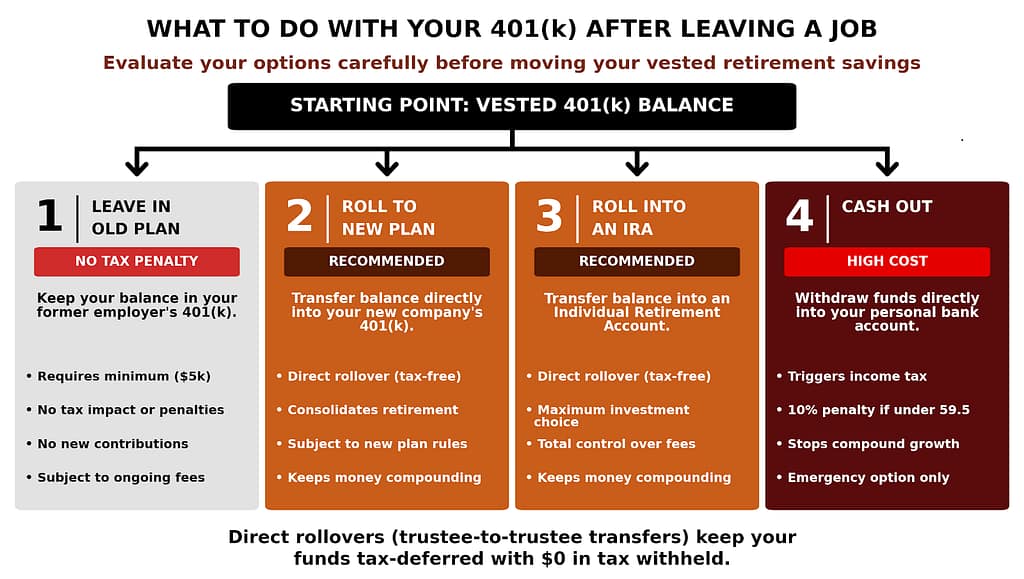
Your vested balance goes with you regardless of why you leave. You generally have four options:
- Leave the account in your former employer’s plan, if the balance meets the plan’s minimum threshold
- Roll the balance into your new employer’s 401(k) plan
- Roll the balance into an Individual Retirement Account (IRA) at a financial institution of your choice
- Cash it out, which triggers ordinary income tax plus a 10 percent early withdrawal penalty if you are under 59.5 years old
The rollover options are straightforward and do not trigger taxes when executed correctly as a direct transfer. Cashing out is the option to avoid unless there is no alternative: the combination of income tax plus penalty can eliminate a significant portion of your balance immediately.
If you want help thinking through a job transition and what it means for your retirement account, a free RedSky Money coach can work through it with you, no sales pitch, no products, just clarity. Schedule a free Discovery Call.
Conclusion
Maximizing your 401(k) employer match is the single highest-return first step available to most early-career workers, because the match represents an immediate and guaranteed return on those contributed dollars. Start by contributing at least enough to capture the full match. Decide between Roth and traditional contributions based on your current and expected tax situation. And check your vesting schedule before any job change so you do not leave employer money on the table.
If you want to talk through your specific numbers with someone who is not trying to sell you anything, RedSky Money offers free one-on-one financial coaching for early-career adults. Schedule a Discovery Call.
Ready to Make the Most of Your 401(k) Match?
Your 401(k) employer match is additional pay you have already earned. A free RedSky Money coach can help you set a contribution strategy that captures it fully, without selling you a single financial product. Schedule your free Discovery Call.
RedSky Money is a nonprofit. Our coaches are CFPs and AFCs, we sell no products, and coaching is always free.