

Choosing health insurance at work is one of the most consequential financial decisions you make each year, yet most employees spend fewer than 30 minutes on it. This post breaks down how to choose health insurance at work in plain language: the difference between HDHP, PPO, HMO, and EPO; how an HSA and FSA compare; and the practical questions that point you toward the right plan. By the end, you will know how to compare your options without needing a background in insurance.
Why Choosing Health Insurance at Work Feels So Complicated
Most employers offer at least two or three health plan options, and figuring out how to choose health insurance at work can feel like decoding a legal brief. The terminology shifts between plans, the fine print matters, and the wrong choice can cost you hundreds or thousands of dollars before the year ends.
The reality is that the decision usually comes down to a handful of practical questions: How often do you actually use medical care? Do you take regular prescriptions? Can you handle a larger bill if something unexpected happens? Once you have honest answers to those three questions, the plan comparison gets much more manageable.
According to a 2025 industry survey, 86 percent of employees say they feel confused by their benefits during open enrollment. If that includes you, you are in the majority, not behind the curve. (Source: Business Solver, as reported by Paycor)
The Five Terms You Need Before You Compare Any Plans
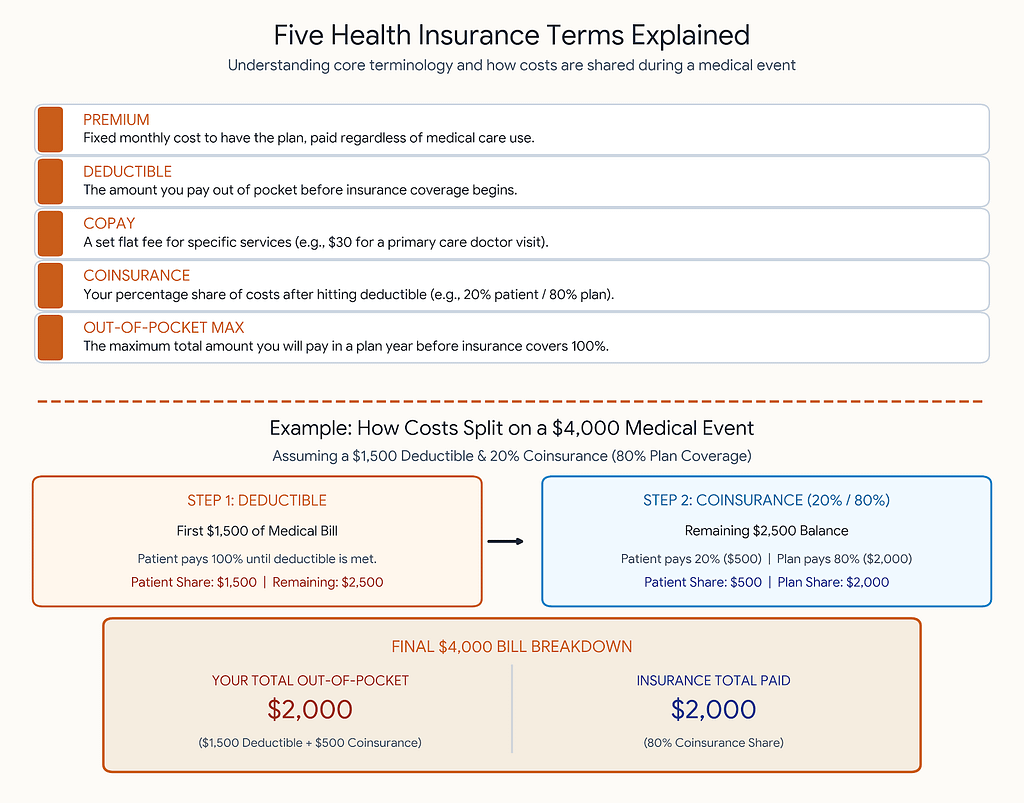
You do not need to understand insurance deeply to make a good choice. You need five terms:
- Premium: the fixed monthly cost of having the plan, whether or not you use it.
- Deductible: the amount you pay out of pocket before your insurance starts covering most costs.
- Copay: a flat fee for a specific service, such as $30 for a primary care visit.
- Coinsurance: the percentage you pay after hitting your deductible, such as 20 percent of a bill.
- Out-of-pocket maximum: the most you will pay in a single plan year before your insurance covers 100 percent of costs.
The out-of-pocket maximum is the number most people underweight. It is your ceiling on financial exposure for the year, which means a plan with a higher deductible is not necessarily riskier if its out-of-pocket max is comparable to a lower-deductible option.
HMO, PPO, EPO, and HDHP: Which Plan Type Fits Your Life?
The four plan types you are most likely to see during open enrollment each balance monthly cost against flexibility in different ways.
An HMO (Health Maintenance Organization) requires you to choose a primary care physician who coordinates your care and provides referrals to specialists. Premiums are typically the lowest of the four types, but you are limited to in-network providers only.
A PPO (Preferred Provider Organization) offers more flexibility: you can see specialists without a referral and access out-of-network providers, at a higher cost. PPO premiums are higher in exchange for that choice.
An EPO (Exclusive Provider Organization) sits in between. You get PPO-style access within a specific network, with no referrals required, but no out-of-network coverage.
An HDHP (High Deductible Health Plan) carries the lowest monthly premium but the highest deductible. Its primary advantage is eligibility for a Health Savings Account (HSA), which is one of the most powerful financial tools available in most benefits packages.
When an HDHP Makes More Sense Than a PPO
If you are generally healthy, visit the doctor infrequently beyond annual preventive care, and do not take regular prescriptions, an HDHP can save you a meaningful amount in premiums over the course of a year. The trade-off is exposure to a higher upfront cost if something unexpected happens.
The key question is simple: do you have enough saved to cover your deductible if you face an unexpected medical bill? If yes, the HDHP plus HSA combination becomes the most tax-efficient way to manage health care costs that most employer benefit packages offer.
HSA vs. FSA: Your Two Tax-Advantaged Health Care Accounts
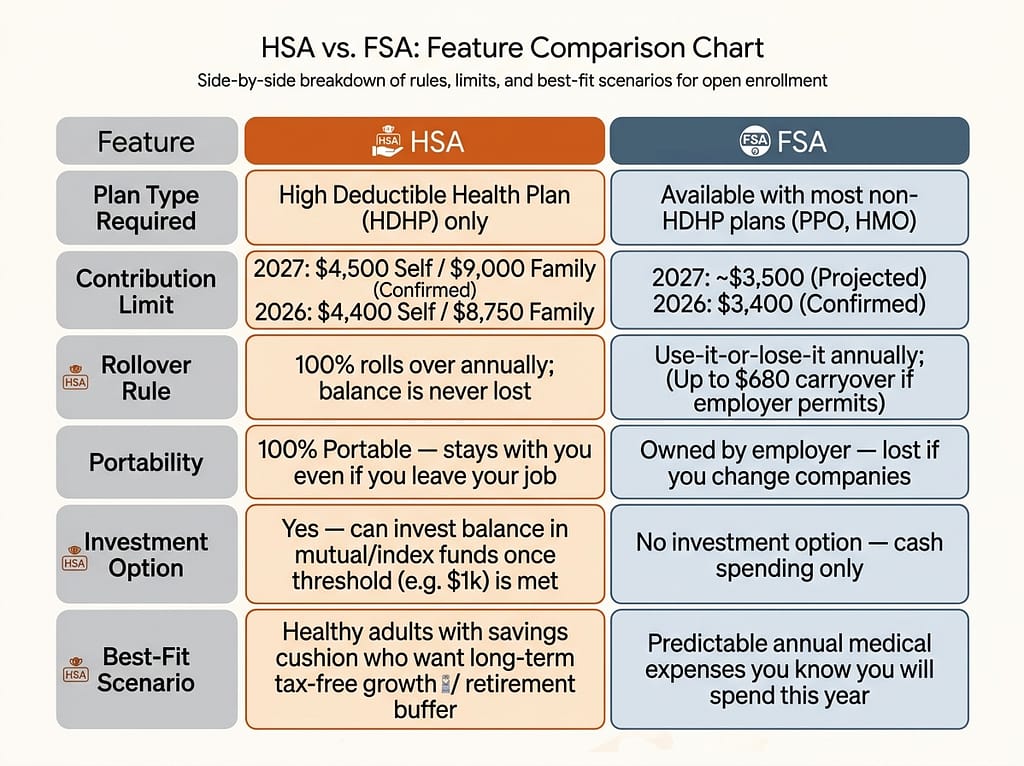
Both a Health Savings Account (HSA) and a Flexible Spending Account (FSA) let you set aside pre-tax dollars to pay for eligible medical expenses. The differences between them matter significantly when you are choosing health insurance at work.
An HSA is only available if you are enrolled in an HDHP. For 2027, the IRS has already confirmed contribution limits of $4,500 for self-only coverage and $9,000 for family coverage, increases from the 2026 limits of $4,400 and $8,750 (Source: IRS Revenue Procedure 2026-24). The money you contribute rolls over every year, can be invested once your balance clears a threshold set by your plan provider, and stays with you even if you leave your employer.
An FSA is available through most non-HDHP plans and does not require a high-deductible plan to access. The confirmed limit for 2026 is $3,400, with early projections pointing to a modest increase to roughly $3,500 for 2027 (Source: IRS; Mercer as reported by BenefitsUSA). The key limitation is the use-it-or-lose-it rule: money not spent by year-end is forfeited, though some employers allow a small carryover of up to $680 under 2026 plan rules.
Think of an HSA as a long-term savings account that happens to cover medical costs. An FSA is a short-term budgeting tool for expenses you already expect to have this year. The right one depends almost entirely on which plan type you choose.
If you have child or dependent care expenses, a separate Dependent Care FSA allows up to $7,500 per household annually, a limit set by recent legislation rather than inflation adjustments, so it is not expected to shift in the near term (Source: IRS).
Are HSA Contributions Worth Investing?
Once your HSA balance clears a threshold, usually around $1,000, most plan providers allow you to invest the excess in mutual funds or index funds. That money grows tax-free, and qualified medical withdrawals are also tax-free. After age 65, you can withdraw for any reason, paying ordinary income tax on non-medical withdrawals, making the HSA function similarly to a traditional IRA for non-medical spending.
Used intentionally, an HSA can serve as a secondary retirement account: pay current medical costs out of pocket when you can, let the HSA balance grow, and draw on it tax-free for health care expenses in retirement, when those costs are typically highest.
Dental and Vision: Small Premiums, Real Value
Dental and vision plans typically add only a few dollars per paycheck, and they cover routine preventive care almost entirely: cleanings, X-rays, and annual eye exams. For most early-career adults, enrolling in both is straightforward math. If you already wear glasses or contacts, or want to stay current on dental care, these plans tend to pay for themselves on routine care alone.
The one case worth reconsidering: if you have strong out-of-pocket rates through a dental discount plan or are covered under a partner’s benefits, running the numbers first takes five minutes and is always worth it.
How to Choose Health Insurance at Work: A Simple Decision Framework
Three questions narrow the choice for most people:
- How often did I actually use health care in the past 12 months, including prescriptions?
- Do I have enough saved to cover my deductible if something unexpected happens?
- Do I have a preferred doctor, specialist, or pharmacy I need to confirm is in-network?
If your answers point toward infrequent use, a healthy savings cushion, and flexibility about providers, an HDHP is a strong candidate. Pair it with an HSA and let the tax savings compound over time. If you use the health system more regularly or have ongoing prescription costs, a PPO or HMO likely offers better trade-offs even at a higher monthly premium.
If you want to think through your specific plan options with someone who has no stake in which plan you choose, a free RedSky Money coach can help you run the comparison in real terms. Schedule a free Discovery Call.
Conclusion
Choosing health insurance at work does not require expertise. It requires honest answers to a few practical questions and a clear understanding of what you are comparing. Know the five core terms. Understand your plan type options. Decide whether an HSA or FSA fits your situation. And add dental and vision if your routine care makes them cost-effective.
The right health plan is simply the one that fits your actual health history, your budget, and your tolerance for financial uncertainty in the year ahead.
Want a Second Opinion on Your Health Plan Options?
Open enrollment decisions move fast. If you want a clear-eyed second opinion on your health plan options before your deadline, a free RedSky Money coach can walk through the comparison with you, no sales pitch, no products, no pressure. Schedule your free Discovery Call.
RedSky Money is a nonprofit. Our coaches are CFPs and AFCs, we sell no products, and coaching is always free.