


Student loan refinancing sounds straightforward: trade your current loans for a new one at a lower interest rate and save money over time. For borrowers with federal loans, though, refinancing permanently closes the door on income-driven repayment, forgiveness programs, and the hardship protections built into federal student loan law. This guide covers exactly what student loan refinancing does, what it costs you, and the specific situations where it can be the right financial move.
What Student Loan Refinancing Actually Does
When you refinance student loans, a private lender pays off your existing loans and issues you a new loan with new terms, typically a lower interest rate, a different repayment period, or both. The new loan is entirely private, regardless of whether your original loans were federal, private, or a combination of both.
Student loan refinancing is different from federal Direct Consolidation, which is a federal program that combines multiple federal loans into one new federal loan while keeping everything within the federal system. Refinancing moves your loans out of that system permanently.
That distinction matters more than most student loan refinancing advertisements acknowledge.
The Real Cost of Student Loan Refinancing: What You Give Up Permanently
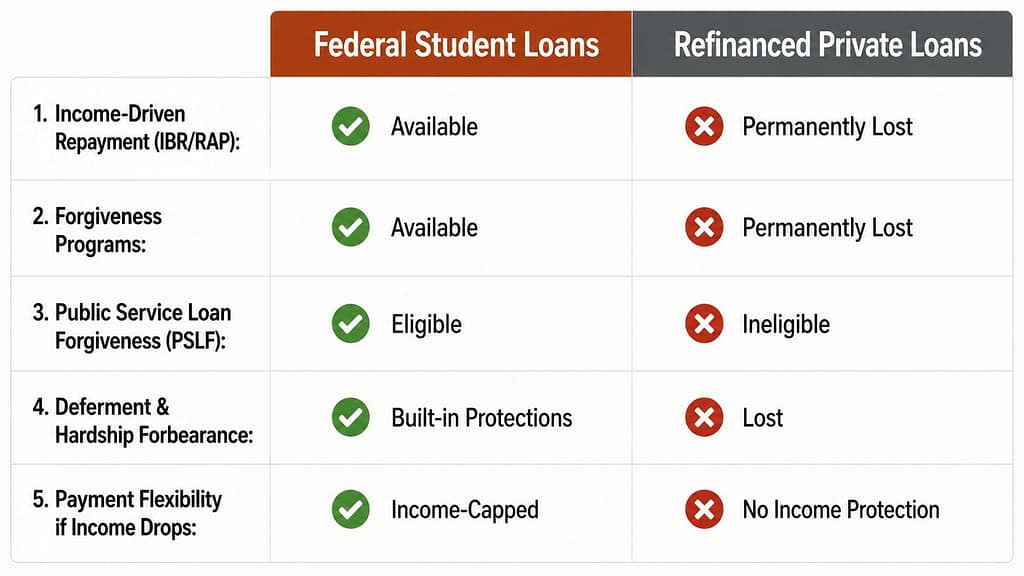
When you refinance federal loans into a private loan, you permanently lose access to every federal protection those loans carry. That includes income-driven repayment plans like IBR and RAP, which cap your monthly payment based on your income. It includes forgiveness programs like Public Service Loan Forgiveness and IDR forgiveness after 20 or 30 years. It includes deferment and forbearance options during periods of financial hardship. None of those protections exist in the private loan market.
This trade-off is permanent. Once you refinance federal loans into a private loan, you cannot move them back into the federal system. There is no reversal, no grace period, and no exception. If your income drops, your employer qualifies for PSLF, or a new hardship protection becomes available, you will not have access to any of it.
If there is any possibility you will work in public service, experience an income disruption, or want the option to use income-driven repayment in the future, refinancing federal loans is very likely not worth the trade-off. This decision cannot be undone.
When Private Student Loan Refinancing Can Make Financial Sense
Refinancing is not the right move for most federal loan borrowers, but there are specific situations where the math can work in your favor.
The clearest case is if you have only private loans to begin with. Private loans do not carry federal protections, so there is nothing to lose from refinancing them. If you can qualify for a meaningfully lower interest rate, the savings may be worth the switch, provided you compare the total cost of the loan over its full term.
Refinancing federal loans may also work if you have a strong credit score and stable, higher income; you are confident you will not need income-driven repayment or forgiveness now or in the future; and you can qualify for a rate low enough to produce real total savings, not just a lower monthly payment.
Comparing monthly payments alone is not enough. A lower monthly payment with a longer repayment term can mean paying significantly more in total interest than your original loan. Always compare the total cost over the full loan term before making any refinancing decision.
How to Evaluate Whether Student Loan Refinancing Is Right for You
Before deciding, run the full numbers on both loans. Look at total interest paid over the life of each loan at the current terms, not just the monthly payment difference. A lower monthly payment stretched over a longer term is not automatically a better deal.
Also assess your career path honestly. If there is any realistic chance you will work for a qualifying PSLF employer at some point in the next 10 years, the potential forgiveness of a large remaining balance is almost certainly worth more than a lower interest rate on a private loan.
Not sure whether refinancing makes sense for your specific loan balance, income, and career trajectory? A free RedSky Money coach can run through the numbers with you before you commit to anything. Book a free Discovery Call.
Final Thoughts on Student Loan Refinancing
The appeal of student loan refinancing is real: a lower interest rate, a smaller monthly payment, and a cleaner picture of your debt. So is the cost: permanent loss of the federal protections that make student loans manageable when life does not go according to plan.
For most early-career borrowers with federal loans, especially those whose income may be unpredictable or whose career might include public service, those protections are worth keeping. Student loan refinancing is the right tool for a narrow set of situations, not a default upgrade.
Understand what you are giving up, compare the total cost of both options over the full repayment term, and assess your career path before committing. And if you are not certain, get a second opinion from someone who earns nothing from the transaction.
Not Sure Whether to Refinance Your Student Loans?
Not sure whether refinancing is the right move for your loans and career path? A free RedSky Money coach can help you run the numbers and think through the trade-offs with no sales pressure.
RedSky Money is a nonprofit. Our coaches are CFPs and AFCs, we sell no products, and coaching is always free.