

An HSA and an FSA both let you pay for medical expenses with pre-tax money, which effectively gives you a discount on every prescription, copay, and dental appointment you cover out of pocket. But the two accounts operate under very different rules: one stays with you for life and accumulates over time, while the other resets every year with a hard deadline to spend what you put in. Understanding the HSA vs. FSA distinction before you open your enrollment portal is one of the higher-value decisions you can make during open enrollment.
HSA vs. FSA: The Key Difference at a Glance
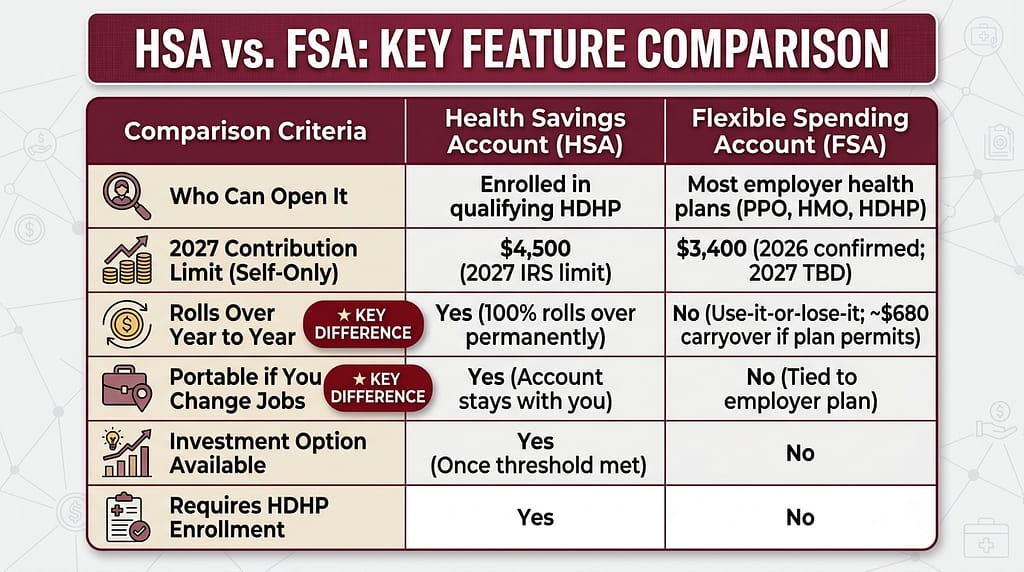
The most important distinction between these two accounts is ownership. An HSA, or Health Savings Account, belongs to you. You open it, the funds roll over year after year with no expiration, and if you change jobs or switch health plans, the money comes with you.
An FSA, or Flexible Spending Account, belongs to your employer’s plan. It resets each year, and money you do not spend by the deadline is typically forfeited back to the plan.
The second major difference is eligibility. An HSA is available only if you are enrolled in a qualifying high-deductible health plan. An FSA is available with most employer health plans: PPOs, HMOs, and others, which means you may be eligible for one regardless of which health plan you choose during open enrollment.
The core HSA vs. FSA distinction: an HSA is a portable savings account you own permanently, and an FSA is a plan-year spending account you need to use or lose.
How a Health Savings Account (HSA) Works
To open and contribute to an HSA, you must be enrolled in an HDHP that meets the IRS’s minimum deductible requirements for the year. For 2027, the IRS has set the contribution limit at $4,500 for self-only coverage and $9,000 for family coverage, with an additional $1,000 catch-up contribution allowed starting at age 55. Contributions can come from you, your employer, or both, and all of it lowers your taxable income for the year.
Money in your HSA can be invested once the account balance clears a threshold set by your HSA provider. This allows the account to grow over time rather than sitting idle, which can turn your healthcare account into a meaningful long-term savings tool. After age 65, you can withdraw HSA funds for any purpose without penalty, similar to a traditional IRA, making it one of the few accounts that offers both short-term medical coverage and long-term wealth-building potential.
The Triple Tax Advantage
The HSA offers three distinct tax benefits in one account: contributions go in tax-free, growth is tax-free if the account is invested, and withdrawals for qualified medical expenses come out tax-free. No other common financial account delivers all three simultaneously. For early-career workers who are watching every paycheck carefully, this combination is worth factoring into your HDHP vs. PPO comparison, not just your account election.
How a Flexible Spending Account (FSA) Works
An FSA lets you set aside pre-tax dollars for medical expenses, similar to an HSA, but under a different ownership structure and spending timeline. The confirmed 2026 healthcare FSA contribution limit is $3,400. The 2027 limit will be announced by the IRS typically in October or November, so your employer’s open enrollment materials should reflect the current confirmed figure when your window opens.
Because an FSA is owned by your employer’s plan, it does not follow you if you leave your job. The benefit of an FSA is that it is available to a broader group of employees, regardless of which health plan you choose. The trade-off is the use-it-or-lose-it structure, which requires careful planning to avoid forfeiting money you contributed.
The FSA “Use-It-or-Lose-It” Rule and How to Avoid Forfeiting Money
The single most important thing to understand about an FSA is the use-it-or-lose-it rule. Money you do not spend by the end of the plan year, or during a short grace period your employer may offer, is forfeited back to the plan. Some employers allow a limited carryover: roughly $680 for the 2026 plan year.
But you need to confirm this in your specific plan documents before you count on it. Do not assume the option exists.
Over-contributing to an FSA and forfeiting the balance is effectively a pay cut. The way to avoid this is straightforward: use your actual prior-year healthcare spending as the baseline, not a round number, and contribute only what you are confident you will spend within the plan year.
HSA vs. FSA: Which One Is Right for You?
This decision is largely shaped by the health plan you are selecting during open enrollment. If you are choosing an HDHP, you are eligible for an HSA, and you should seriously consider opening one. The rollover, portability, and investment features make an HSA the stronger long-term account for most people who qualify, particularly if your employer contributes to employee HSAs as part of the benefits package.
If you are selecting a PPO or any plan that does not meet HDHP requirements, an HSA is not available to you, and an FSA becomes the primary tool for tax-advantaged healthcare savings. In that case, plan your FSA contribution conservatively using last year’s actual spending, and confirm whether your employer allows a grace period or partial carryover before you lock in an amount.
One edge case worth knowing: if you have an HSA and want to contribute to an FSA in the same plan year, the FSA must be a “limited-purpose” FSA, restricted to dental and vision expenses only, to avoid violating IRS rules. This applies only if you are managing both account types simultaneously, which comes up more often as employees change plans mid-career.
Contributing 30 minutes to the HSA vs. FSA question before you open your enrollment portal is one of the highest-return tasks on your open enrollment checklist. Getting the account choice wrong, or skipping it entirely, can mean leaving thousands of tax-free dollars uncontributed over just a few years.
How to Estimate How Much to Contribute
The most reliable starting point for your contribution estimate is what you actually spent on healthcare last year. Pull together prescription costs, doctor visit copays, dental work, vision care, and any other out-of-pocket medical expenses. That total is your baseline for the year ahead.
From there, adjust for anything you can reasonably anticipate: a planned procedure, a new prescription, annual contact lens purchases, or any dental work you have been putting off. For an FSA, stay conservative rather than rounding up, since you cannot recover money you contribute and do not spend. For an HSA, contributing the maximum you can afford is generally the stronger move, since the funds do not expire and can be invested.
If you want help working through this estimate against your actual income and spending, a free coaching conversation can make that math faster and more precise. A RedSky Money coach can walk through your numbers without selling you any products or steering you toward a specific account provider. Book a free Discovery Call.
Conclusion
The HSA vs. FSA decision matters more than most people realize when they open their enrollment portal. An HSA can become one of the most tax-efficient accounts you own if you contribute to it consistently and let it grow over time. An FSA is a useful tool in the right situation, but it requires disciplined contribution planning to avoid forfeiting money at the end of the plan year.
Your eligible account type is determined by the health plan you select, which means the HDHP vs. PPO decision and the HSA vs. FSA decision are connected. Work through both before you submit.
Ready to make sense of your HSA and FSA options?
Whether you are choosing between an HSA and an FSA, or still working through your health plan options, a free Discovery Call with a RedSky Money coach puts a knowledgeable set of eyes on your specific situation: no products, no commissions, just clarity on the choices that affect your paycheck and your health costs.
RedSky Money is a nonprofit. Our coaches are CFPs and AFCs, we sell no products, and coaching is always free.