

HSA and FSA look nearly identical on any benefits enrollment form. They work in fundamentally different ways. Knowing who owns each account and what happens to unspent money matters. This guide covers every meaningful HSA vs. FSA difference so you can decide with confidence before your enrollment window closes.
What HSA vs. FSA Differences Actually Mean for Your Paycheck
Both a Health Savings Account (HSA) and a Flexible Spending Account (FSA) are pretax health accounts. Contributions come out of your paycheck before income taxes are calculated on that money. Three things determine which account fits: who owns it, how long the money lasts, and which health plan qualifies you.
Most people choose based on dollar amounts alone. They do not realize that account structure matters as much as contribution limits. Getting this wrong can mean forfeited balances or missed savings. It can also mean choosing a plan that does not fit how you use healthcare.
What Is a Health Savings Account (HSA)?
An HSA is a personal savings account for qualified medical expenses. It comes with a tax structure called the triple tax advantage. Contributions go in pretax, the balance grows tax-free, and withdrawals for eligible expenses come out tax-free too.
The account belongs to you personally, not your employer. If you change jobs, go freelance, or take time away from work, the money stays yours. Nothing resets and nothing gets left behind.
What Is a Flexible Spending Account (FSA)?
A Flexible Spending Account is also a pretax account for medical expenses. Your employer owns and administers it, not you. FSAs typically pair with traditional health plans. Those plans come with flat copays and a lower annual deductible. You do not need to meet a large deductible before coverage kicks in.
One of the FSA’s most practical features is front-loaded access. Your full annual election is available on day one. That is true even before contributions have been deducted from your paycheck. The tradeoff is that FSAs do not travel with you when you leave a job.
Before comparing limits and rollover rules, find out which account your health plan qualifies you for. A free RedSky Money coach can review your plan documents with you before enrollment closes.
HSA Eligibility: Why Your Health Plan Determines Your Options
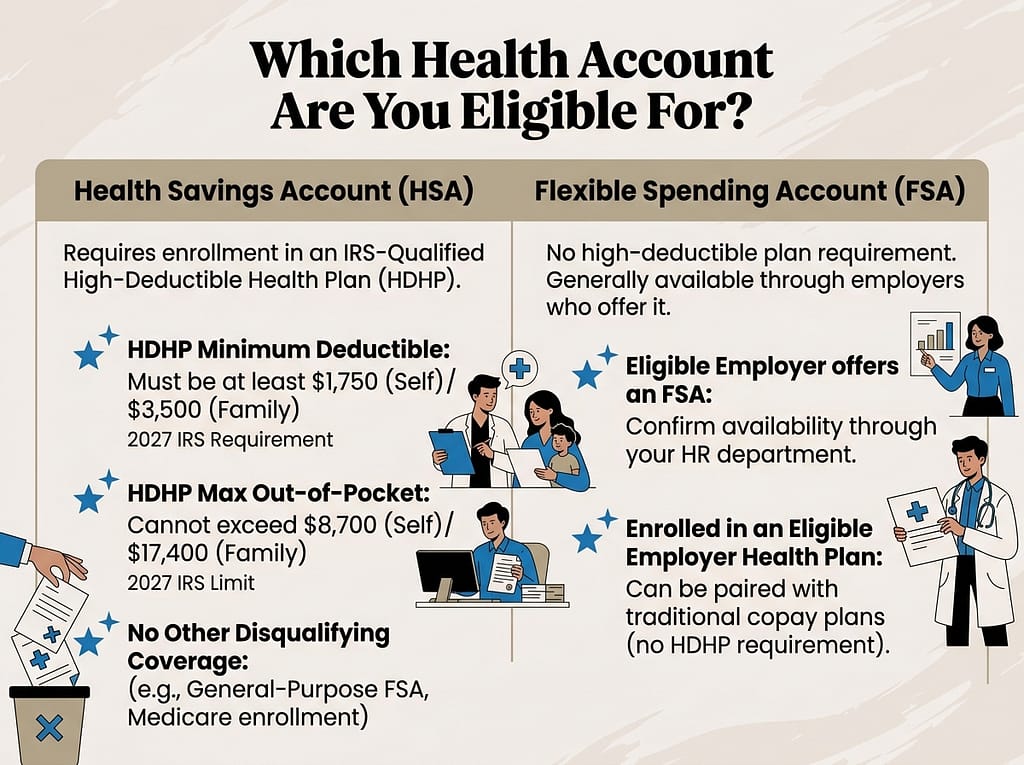
To open or contribute to an HSA, you must be enrolled in a High Deductible Health Plan, or HDHP. For 2027, the IRS requires a minimum HDHP deductible of $1,750 for self-only coverage or $3,500 for family coverage. The out-of-pocket maximum cannot exceed $8,700 for self-only or $17,400 for family coverage (Source: IRS, Rev. Proc. 2026-24). If your plan does not meet those thresholds, you cannot contribute to an HSA. That is true regardless of what your employer calls the plan.
FSA eligibility is more flexible on the plan side. Employers typically pair FSAs with traditional copay plans. There is no HDHP requirement. If your employer offers an FSA alongside your current plan, you can generally use it. For a side-by-side comparison of HDHPs and PPOs, see our guide on choosing between an HDHP and a PPO.
HSA vs. FSA Rollover Rules: Unlimited Growth vs. Use-It-or-Lose-It
HSA money never expires. Whatever you do not spend keeps accumulating year after year. Many HSA providers let you invest the balance once it crosses a minimum threshold. That threshold is often around $1,000 to $2,000, with fund options similar to a 401(k). An HSA can build into a meaningful balance over the years. That is true even if you contribute modest amounts each paycheck.
FSAs run on a “use it or lose it” rule tied to the plan year. Some employers soften that rule with one of two options. The first is a grace period of up to two and a half months after the plan year ends. The second is a limited carryover of up to $680 from a 2026 plan year (Source: IRS, Rev. Proc. 2025-32). Employers can offer one or the other, but not both. If your employer offers neither, any money left in your FSA when the year closes is forfeited.
Few open enrollment decisions have as much long-term financial impact. The difference between losing unused money at year-end and watching it compound indefinitely is significant.
HSA Portability: What Happens to Your Account When You Change Jobs?
Early-career professionals change employers more often than any other age group. For them, portability may be the single most important distinction between these two accounts. An HSA is yours permanently, regardless of employer, health plan, or employment status. Even if you later become ineligible to contribute, the existing balance remains yours. You can still spend it on qualified medical expenses.
An FSA is tied to a specific employer and a specific plan year. Leave mid-year, and the remaining balance generally does not transfer with you.
2027 Contribution Limits and the Tax Advantage Explained
For 2027, the HSA limit is $4,500 for self-only coverage and $9,000 for family coverage. Adults 55 and older can add an extra $1,000 catch-up contribution (Source: IRS, Rev. Proc. 2026-24). The 2026 health FSA limit is $3,400 per employee (Source: IRS, Rev. Proc. 2025-32). The IRS releases the next year’s FSA figure each fall. Verify the 2027 number at IRS.gov when your enrollment materials arrive.
Both accounts reduce your taxable income by the amount you contribute. That is why pretax health accounts are sometimes called a built-in pay raise. The IRS adjusts these limits annually for inflation. Treat any specific figure, including the ones in this post, as a snapshot to verify before finalizing your election.
Eligible Expenses: What Both Accounts Actually Cover
Both accounts cover the same IRS-qualified medical expenses (Source: IRS, Publication 502). Covered items include copays, deductibles, coinsurance, and prescriptions. Contact lenses, glasses, dental care, mental health counseling, and many over-the-counter items also qualify.
Neither account covers cosmetic procedures, gym memberships used for general wellness, or health insurance premiums in most situations. Keep receipts for every purchase you make with either account. Plan administrators can request documentation proving a purchase qualifies, and the burden of proving eligibility is yours.
Can You Have Both an HSA and an FSA at the Same Time?
The short answer for most people is no, with one useful exception. The IRS treats a standard general-purpose FSA as disqualifying coverage for HSA purposes. If you contribute to a full FSA, you cannot also contribute to an HSA in the same plan year. That is true even if you are enrolled in an HDHP. The IRS considers a general FSA a form of first-dollar coverage that conflicts with the high-deductible structure behind HSA eligibility.
The Limited-Purpose FSA Exception
A Limited-Purpose FSA, or LPFSA, covers only dental and vision expenses. Those categories do not conflict with HSA eligibility rules. This allows an LPFSA to run alongside an HSA at the same contribution limit as a standard FSA. If you already expect predictable dental or vision costs, an LPFSA is worth asking about. It lets you keep building your HSA while covering routine dental and vision care with pretax dollars.
Not all employers offer this option. Ask your HR team directly whether a limited-purpose FSA is available alongside your HDHP.
A free Discovery Call is a low-pressure way to get a second opinion before your enrollment window closes. Schedule.
Your Next Step: From Understanding to Deciding
Knowing how HSAs and FSAs work is the foundation. The next step is applying that knowledge to your own situation. Consider your health plan, spending patterns, and finances to figure out which account fits. For a step-by-step decision framework and cost estimation exercise, see our guide on how to choose between an HSA and FSA for your budget.
Conclusion
HSAs and FSAs both let you pay for medical costs with pretax dollars. The differences that matter most are ownership, rollover rules, and health plan eligibility. An HSA belongs to you permanently, grows without a deadline, and requires enrollment in an HDHP. An FSA gives you immediate access to your full annual election. It is tied to your current employer and plan year. Knowing which structure fits your situation is the starting point for every open enrollment decision that follows.
Ready to make the right call on your health account?
Open enrollment moves fast, and the account you choose follows your paycheck for the next twelve months. A free RedSky Money coach can help you read your plan documents, compare your options, and walk away confident your decision actually fits your budget. Schedule a free Discovery Call.
RedSky Money is a nonprofit. Our coaches are CFPs and AFCs, we sell no products, and coaching is always free.