
Understanding what HSAs and FSAs are is the first step. The harder question is which one belongs in your benefits package. Three factors determine the answer: your health plan options, how predictable your spending is, and your available cash cushion. This guide walks through a practical decision framework. It also covers the mistakes that trip up most people during their first open enrollment.

The Question That Actually Drives the HSA vs. FSA Decision
Your health plan is the first filter. You can only contribute to an HSA if you are enrolled in a High Deductible Health Plan (HDHP). If your employer does not offer an HDHP, your decision is largely made. The same is true if you prefer a plan with lower upfront costs and predictable copays. In that case, an FSA is your option.
If both account types are available to you, the choice comes down to three questions. How predictable are your medical expenses this year? How much financial cushion do you have to cover a higher deductible if something unexpected happens? And how much do you value long-term, tax-free savings versus immediate access to funds? For a full explanation of how each account is structured, see our breakdown of HSA vs. FSA key differences.
When Choosing an HSA Makes Sense for Early-Career Adults
An HSA paired with an HDHP works well if you are generally healthy and rarely visit the doctor. You also need enough savings to cover your plan’s deductible if something unexpected happens. Lower HDHP premiums free up cash today. Money you do not spend keeps accumulating tax-free for years, with no expiration date.
Some people in their twenties barely touch their HSA. They treat it as a second retirement account earmarked for future healthcare costs. After age 65, HSA funds can be withdrawn for any purpose. Withdrawals are taxed as ordinary income, the same as a traditional IRA. That flexibility makes consistent HSA contributions a meaningful long-term strategy. It is especially valuable for healthy adults with minimal healthcare spending now.
How Premium Savings and Tax-Free Growth Add Up Over Time
The HDHP premium difference alone can be meaningful. If your HDHP premium is $80 to $100 lower per month, that adds up to $960 to $1,200 a year. That money could go into your HSA or your emergency fund instead. Over time, an invested HSA balance compounds at whatever rate your provider’s funds earn. None of those gains are taxed when spent on qualified medical expenses.
Few accounts escape federal income tax at every stage: contributions, growth, and qualified withdrawals. An HSA does. That structure is why planners often recommend maximizing an HSA before going beyond the 401(k) employer match. This is especially relevant for those with low medical expenses now.
When Choosing an FSA Is the Safer Option
If your medical costs are predictable and recurring, an FSA paired with a traditional plan may be the cleaner option. Ongoing prescriptions, orthodontic work, or a scheduled procedure give you a real number to elect. You are not guessing at a rough estimate.
You also get your full annual election on day one of the plan year. That matters if a large expense lands in January before contributions have time to build. A traditional plan’s lower deductible also caps your exposure on unexpected costs. That protection matters if something unplanned happens on top of what you already budgeted.
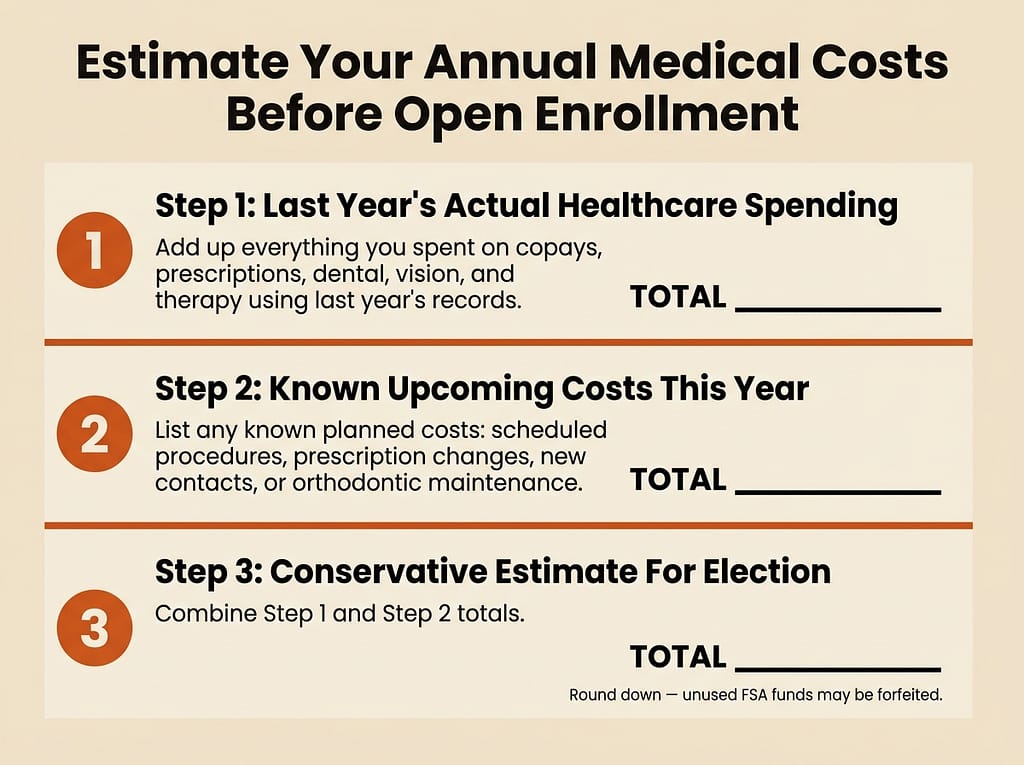
How to Estimate Your Annual Medical Costs Before You Elect
This exercise takes about fifteen minutes and resolves most of the guesswork before you commit to either account.
Step one: Pull up last year’s bank or credit card statements. Add up every dollar you spent on healthcare: copays, prescriptions, dental, vision, and therapy.
Step two: Add any costs you already know are coming. That includes a scheduled procedure, a prescription change, new contacts, or orthodontic maintenance.
Step three: Round your estimate down slightly rather than up. A small out-of-pocket expense paid from your regular account hurts less. Money stranded in a forfeited FSA is gone entirely.
That exercise changes the framing from “which sounds better” to “which fits what I actually spend.” Peterson-KFF data found that close to one in three single-person households with private insurance lacked $2,000 in savings. (Source: Peterson-KFF Health System Tracker, 2024). Going into open enrollment with a real spending number prevents that kind of financial exposure from quietly getting worse.
Common HSA and FSA Mistakes That Cost People Real Money
Overfunding an FSA and Losing the Balance
Unspent FSA money is either forfeited or capped, depending on your employer’s rules. Overestimating your annual election is one of the most common and expensive early-career benefits mistakes. If this is your first year, start with a conservative estimate based on actual past spending. One full year of real data is worth more than any projection you make during enrollment.
Treating Your HSA Like a Checking Account
An HSA debit card works just like a regular card at the pharmacy. That makes it easy to spend down the balance each year. In doing so, you give up the account’s biggest advantage: tax-free growth over time. Only 18% of HSA holders invested any of their balance beyond cash in 2024. (Source: EBRI, HSA Trends Report, 2026) If your cash flow allows it, pay smaller medical costs out of pocket. Let your HSA balance sit and grow instead. Over a decade, that difference can be significant.
Missing the Life Event Window to Update Your Election
Marriage, a new child, losing a spouse’s coverage, or aging off a parent’s plan are all qualifying life events. Each one lets you change your HSA or FSA elections outside of open enrollment. Many early-career adults do not know this window exists. They end up stuck with an outdated election for the rest of the plan year. Most plans give you around 30 days to make the change. Contact HR promptly when something shifts in your household.
How Your Health Account Choice Fits Into Your Larger Budget
An HSA or FSA election does not exist by itself. It interacts with your emergency fund and your debt payments. It also affects how much cash you can keep available for everyday life versus tied up in a tax-advantaged account.
A lower-premium HDHP can free up cash for building savings. But that only works if you already have enough set aside to cover your plan’s deductible. If that cushion is not yet in place, a plan with smaller, predictable costs may make more sense. That is also true if you are focused on paying down high-interest debt, even if the premium runs higher.
This decision looks simple on a comparison chart. In practice, it often comes down to details a formula cannot capture. A free Discovery Call with a RedSky Money coach is available. Use it to see how a health account election fits into your full financial picture.
Conclusion
Choosing between an HSA and an FSA is not a test you pass or fail. It is a practical decision based on three things you can know before enrollment closes. First, what your health plan makes you eligible for. Second, what you realistically spend on medical care. Third, how much financial cushion you have if something unexpected happens. A conservative first-year election is a sound starting strategy. You can revisit the decision during next open enrollment with more data.
Ready to Make Your HSA or FSA Decision with Confidence?
Open enrollment decisions follow you for twelve months, but you do not have to make them alone. A free RedSky Money coach can help you run the numbers, read your plan documents, and walk into benefits selection knowing your choice actually fits your income and your goals. Schedule a free Discovery Call.
RedSky Money is a nonprofit. Our coaches are CFPs and AFCs, we sell no products, and coaching is always free.