

Renting your first apartment costs significantly more than just the monthly rent, and most first-time renters discover that only when the upfront numbers are already due. This guide breaks down every cost you will face before and after move-in day, with real numbers you can use to build a savings target right now. By the end, you will know exactly how much to have ready and how to build a monthly budget that does not fall apart in month two.
What the 30% Rule Actually Tells You About How Much to Spend on Rent
The most widely used starting point for calculating how much money to rent an apartment is the 30% rule: spend no more than 30% of your gross monthly income on rent. It is a useful ceiling, not a hard law, and understanding where it comes from helps you apply it intelligently.
The benchmark originated as a federal housing affordability measure. In high-cost cities, sticking to exactly 30% on an entry-level salary is often impossible. In lower-cost markets, you may land well under it. The number matters most as an upper limit rather than a target.
Here is a quick reference based on monthly take-home pay:
| Monthly Take-Home Pay | Max Rent at 30% |
|---|---|
| $2,500 | $750 |
| $3,000 | $900 |
| $3,500 | $1,050 |
| $4,000 | $1,200 |
| $4,500 | $1,350 |
| $5,000 | $1,500 |
If your ceiling feels out of reach in your target area, a roommate, a smaller unit, or a different neighborhood can all help close the gap. Knowing the math before you start searching keeps you from committing to a rent level you cannot sustain.
According to Apartment List’s 2023 Renter Confidence Survey, 60% of renters in their 20s said they struggled to afford their first apartment because of unexpected move-in costs, not ongoing monthly rent. The upfront number is where most people get surprised.
How Much Money You Need Upfront Before You Get the Keys
This is the section most people skip until it is too late. The monthly rent is visible on every listing. The stack of costs due before you take possession often comes as a shock.
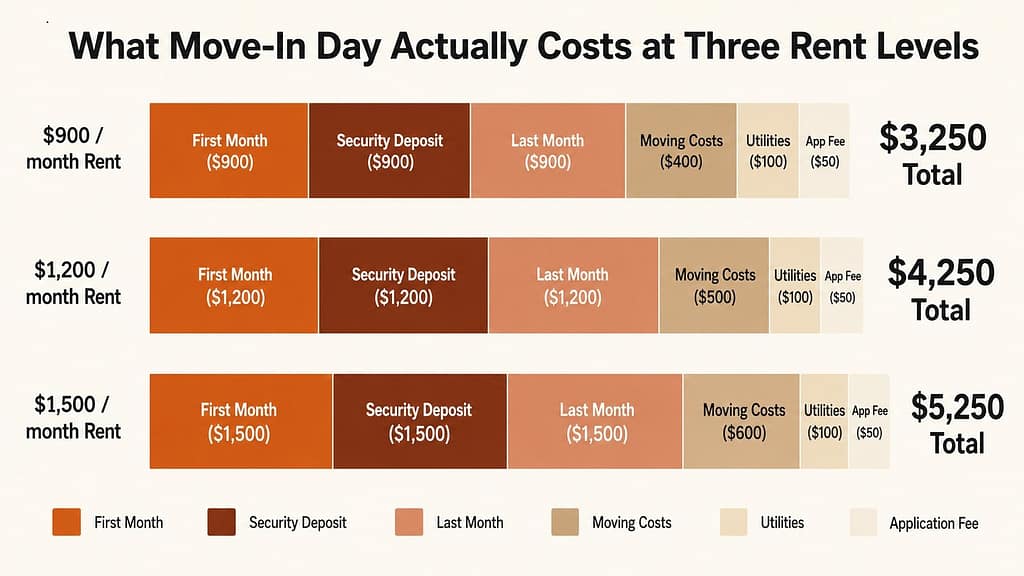
For a $1,200 per month apartment with a pet, you could realistically owe $4,000 to $5,000 before you bring in a single box.
Here is what to budget for:
| Cost Item | Typical Range |
|---|---|
| Security Deposit | 1-2 months’ rent |
| First Month’s Rent | Full rent amount |
| Last Month’s Rent (if required) | Full rent amount |
| Application Fee | $25-$100 per applicant |
| Pet Deposit (if applicable) | $200-$500+ |
| Moving Costs | $300-$1,500+ |
| Utility Setup / Transfer Fees | $50-$200 |
The National Multifamily Housing Council reported in 2023 that the average security deposit nationally equaled one to two months of rent, with many coastal markets requiring the full two-month amount. Budget for the higher end until you confirm the local standard. [
The security deposit alone can run $1,200 to $2,400 for a mid-range apartment. Add first and last month and you can hit $3,600 before accounting for moving costs or fees. Building toward a specific savings target before you start seriously searching is what keeps this stage manageable.
How Much Income You Need to Qualify for the Apartment You Want
Knowing what you can afford is step one. Knowing what landlords will require of you is step two. Most landlords screen applicants using a gross income test, and the standard threshold is 2.5 to 3 times the monthly rent.
For a $1,200 per month apartment, expect to need at least $3,000 to $3,600 in gross monthly income. For a $1,500 per month unit, that range is $3,750 to $4,500.
If your income falls short of the threshold, these options can strengthen your application:
- Apply with a co-signer or guarantor who meets the income or credit requirement
- Offer a larger security deposit to reduce perceived risk
- Provide bank statements demonstrating solid savings
- Find a roommate to split the monthly cost
Understanding this threshold early in your search saves you from applying for units you are unlikely to be approved for, which costs you application fees and time.
How Much Money to Budget for Monthly Apartment Expenses Beyond Rent
The listing price and your real monthly cost are not the same number. Utilities, renters insurance, and other recurring expenses typically add $200 to $500 per month on top of rent.
Budget for these on top of your rent each month:
- Electricity and gas: $50-$150 depending on unit size and climate
- Water and trash: Sometimes included; always confirm with the landlord before assuming
- Internet: $40-$100
- Renters insurance: $10-$25
- Parking: $0-$200 depending on location
- Laundry: $30-$60 if no in-unit machines
LendingTree’s 2022 Renter Financial Behavior Study found that 29% of renters in their 20s did not budget for utilities when planning their first apartment, which contributed to financial shortfalls in the early months of their lease.
Renters insurance deserves special attention. At $10 to $25 per month, it covers your belongings against theft, fire, and water damage and protects you from liability if someone is injured in your unit. Many landlords now require it as a lease condition. Even when they do not, the coverage is worth far more than the monthly cost.
Building Your Move-In Savings Target Before You Start Searching
Now that you know how much money to rent an apartment upfront and monthly, you need a concrete savings plan. The simplest approach is to work backward from your target move-in date.
- Calculate your full move-in cost using the upfront cost table and the rent level you are targeting.
- Add one month of estimated total monthly expenses (rent plus all recurring costs) as a buffer.
- Divide the total by the number of months until you want to move in.
- That is your monthly savings target.
Setting up a dedicated savings account labeled “apartment move-in fund” keeps the money separate and visible. When you can track the progress, you are more likely to stay consistent.
A small emergency reserve matters here too. The first few months in a new apartment come with financial surprises: a utility deposit you did not anticipate, a co-pay that arrives mid-month, or a car repair right before rent is due. Even $500 to $1,000 set aside separately from your move-in fund can keep a minor setback from becoming a real crisis.
If you want a second set of eyes on your savings plan before you commit to any lease, a free RedSky Money coaching session can map it all out with you. Book a free Discovery Call and get a clear picture of your timeline and target.
Conclusion: The Real Number You Need to Rent Your First Apartment
The full cost of renting your first apartment is almost always higher than the listing price suggests. The three things to carry forward: the 30% rule gives you your monthly rent ceiling; upfront costs typically run $3,000 to $5,000 for a mid-range apartment; and your real monthly total will run $200 to $500 higher than rent alone. Build your savings target around the real number and you go into the search with an accurate picture and a plan that holds.
Ready to build your apartment budget before you start searching?
Renting your first apartment is one of the first major financial commitments you will make. A free Discovery Call with RedSky Money connects you with a CFP or AFC coach who can help you plan for rent, savings, and debt in a single conversation. No products. No upsells. Just honest guidance from credentialed coaches who are here to help. Book your free call.
RedSky Money is a nonprofit. Our coaches are CFPs and AFCs, we sell no products, and coaching is always free.