
Complete Guide
How to Build Credit From Zero: A Beginner's Guide to Starting with No Credit History
- ~15 min read
- Written by CFPs and AFCs
- Backed by national research
Maybe you graduated last year. Maybe you moved out on your own for the first time. Maybe you applied for a car loan or an apartment and discovered the same frustrating problem: you cannot get approved because you have no credit history, and you cannot build credit history without getting approved.
That loop can feel like a trap, but it is not. Building credit from zero is genuinely doable, and millions of people do it successfully every year. You just need to understand how the system works and which entry points are actually accessible to someone starting fresh.
This guide walks you through everything: what a credit score actually is, four realistic ways to start building yours, how long it takes, and the most common mistakes to sidestep along the way.
A Note About This Guide and Who Wrote It
This guide was written with input from Accredited Financial Counselors (AFCs) and Certified Financial Planners (CFPs) on the RedSky Money team. It is designed to give you clear, unbiased information about building credit from zero, without steering you toward any product, lender, or service. RedSky Money is a 501(c)(3) nonprofit that offers free financial coaching for early-career adults. If you want a personalized plan, you can schedule a free Discovery Call at any time.
- The Basics: What Is a Credit Score and How Is It Calculated?
- 4 Practical Ways to Build Credit With No Credit History
- The Credit Timeline: How Long Does It Take to Generate a Score?
- Credit Mistakes to Avoid: Protecting Your Score From the Start
- Ready for the Next Step? How Free Financial Coaching Simplifies Credit
- Frequently Asked Questions
- Sources
STEP 1
The Basics: What Is a Credit Score and How Is It Calculated?
A credit score is a three-digit number generated by a mathematical model. It reflects how reliably you have repaid borrowed money in the past. Lenders use it as a quick way to estimate how likely you are to repay future debt.
That is all it is. It is not a measure of how smart you are, how responsible you are as a person, or how financially savvy you will be in the future. It is a data-driven snapshot based on what has shown up in your credit report so far.
The most widely used scoring model is the FICO score, which ranges from 300 to 850. Higher numbers suggest lower risk to lenders. VantageScore is another common model that uses the same range. Both rely on similar data but weight the factors slightly differently.
The 5 Core Elements That Make Up Your Score
FICO calculates your score using five categories of information from your credit report. Here is how each one is weighted:
Factor
Weight
Key Question
Payment History
35%
Do you pay on time?
Credit Utilization
30%
How much of your limit are you using?
Length of Credit History
15%
How long have you had accounts?
Credit Mix
10%
Do you have more than one type of credit?
New Credit Inquiries
10%
Have you applied for credit recently?
Payment history carries the most weight by far. One missed payment can have a noticeable negative effect, which is why building the habit of on-time payments early matters so much. Utilization refers to how much of your available credit you are actively using. The other three factors become more meaningful over time as your credit file grows.
(Source: myFICO.com, Understanding FICO Scores)
Thin File vs. Poor Credit: Knowing Your Starting Point
A thin file simply means you have little or no credit history on record. Credit bureaus do not have enough information about you to generate a reliable score. This is different from having a poor credit history, where negative information like missed payments or collections has already been recorded.
Thin File vs. Poor Credit at a Glance
Thin File: Little or no credit history. Lenders cannot assess your risk. You are starting from a blank slate.
Poor Credit: Negative history already on record. This takes time and effort to repair.
If you have a thin file, you are in a good position. There is nothing to undo.
Having a thin file is not a setback. It is a clean starting point. You have not made any credit mistakes yet because you have not had credit yet. That is actually a useful place to be, because every step you take from here builds positive history from scratch.
Roughly 26 million Americans are considered “credit invisible,” meaning they have no credit history on file at a major bureau. Another 19 million have credit records that are too limited or outdated to score reliably.
(Source: Consumer Financial Protection Bureau, Data Point: Credit Invisibles, 2015)
A free RedSky Money coach can help you understand your starting point and build a practical roadmap from there. Schedule a free Discovery Call.
A free RedSky Money coach can help you understand your starting point and build a practical roadmap from there.
RedSky Money is a nonprofit. Coaching is always free. No products, no upsells, no catch.
STEP 2
4 Practical Ways to Build Credit With No Credit History
There is no single path that works for everyone. The right option depends on your current financial situation, your relationships, and what you are most comfortable with. What follows is a plain-language explanation of four approaches people commonly use to start building credit safely.
Option 1: Becoming an Authorized User on a Trusted Account
If someone you trust, like a parent, sibling, or close family member, has a credit card account with a strong payment history and low balance, they may be willing to add you as an authorized user on that account.
When you become an authorized user, that account’s history may appear on your credit report. If the primary cardholder consistently pays on time and keeps the balance low, that positive history can help establish your own credit profile.
A few things to know about this option:
- You do not need to use the card or even hold it in your hands. Your credit file may benefit just from being listed on the account.
- The primary cardholder remains fully responsible for any charges and payments.
- This only helps you if the primary account holder has strong credit habits. A late payment on their part could show up on your report too.
- Have an honest conversation about expectations with the person adding you.
Option 2: Using Secured Cards Conceptually
A secured credit card is designed specifically for people building or rebuilding credit. To open one, you make a cash deposit upfront. That deposit becomes your credit limit and serves as security for the lender if you do not pay.
You use the card like a regular credit card for everyday purchases. Each month you pay your bill, ideally in full. The card issuer then reports your payment activity to one or more credit bureaus, which builds your credit history over time.
How the deposit works:
- The deposit is not a fee you pay to use the card. It is collateral. If you close the account in good standing after building credit, most issuers return the deposit to you.
- A typical deposit ranges from $200 to $500, but this varies by issuer.
Secured cards are one of the most commonly recommended starting points for thin-file individuals because the approval bar is lower than unsecured cards and the credit-building mechanism works the same way.
When comparing secured card options, look for ones with no or low annual fees, and confirm the issuer reports to all three major credit bureaus.
Option 3: Reporting Rent and Utility Payments
If you pay rent every month, you are making a consistent, on-time payment that most credit bureaus do not see by default. Rent reporting services can change that by forwarding your payment data to one or more credit bureaus, where it may contribute to your credit file.
Some services report to all three major bureaus. Others report to just one or two. Availability and cost vary depending on which service is used and whether your landlord participates or if you self-enroll.
Important to know:
- Not every scoring model incorporates rent data yet, though more are moving in that direction.
- Some rent reporting services charge a monthly fee. Weigh the cost against your situation.
- Utility and phone bill reporting works similarly through some credit reporting programs.
This option appeals to people who want to use bills they are already paying to contribute to a credit profile, without taking on any new debt.
Option 4: Exploring Credit Builder Loans
A credit builder loan works in reverse compared to a traditional loan. Instead of receiving money upfront and paying it back, you make monthly payments first, and the money accumulates in a locked savings account. When you finish all your payments, the full amount is released to you.
Throughout the process, the lender reports your payments to the credit bureaus. That consistent payment record builds your credit history, even though you never borrowed money in the traditional sense.
- Step 1: You apply for a credit builder loan, often through a credit union or community development financial institution (CDFI).
- Step 2: The lender deposits the loan amount into a secured account you cannot access yet.
- Step 3: You make regular monthly payments over 6 to 24 months.
- Step 4: Each payment is reported to the credit bureaus.
- Step 5: At the end of the term, you receive the full amount in the account, minus any fees.
Credit builder loans are particularly useful for people who want to build credit and save simultaneously. They are offered by some credit unions, community banks, and online lenders focused on financial inclusion.
(Source: Consumer Financial Protection Bureau, Building Credit with a Credit Builder Loan)
Each of these options works differently, and the right starting point depends on your specific situation. A free RedSky Money coach can help you think through which path makes the most sense for you, without any pressure or product sales.
RedSky Money is a nonprofit. Coaching is always free. No products, no upsells, no catch.
STEP 3
The Credit Timeline: How Long Does It Take to Generate a Score?
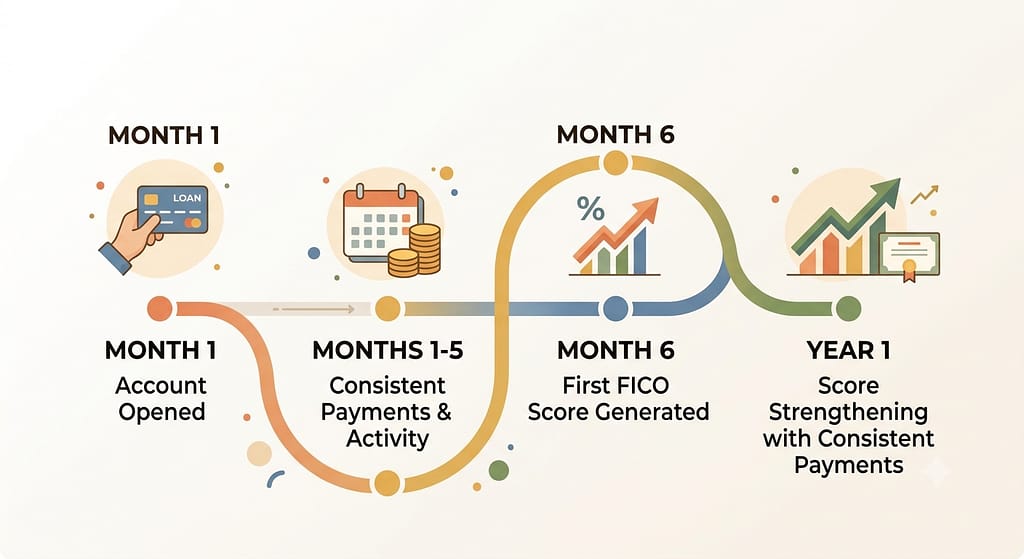
One of the most common questions from people starting out is how long this actually takes. The honest answer: it takes longer than most people expect, but the milestones are clear.
To generate a FICO score for the first time, you generally need at least one account that has been open for six months or more and at least one account that was updated in the past six months.
(Source: myFICO.com, What Is Not in Your FICO Score)
Milestone
Typical Timeframe
Open your first credit account
Day 1
Account appears on your credit report
Roughly 30 to 60 days
First FICO score calculated
Around 6 months of account activity
Score begins to strengthen with good habits
12 months of consistent payments
Score reflects a meaningful credit history
24+ months
These are general benchmarks, not guarantees. Your timeline may vary based on which accounts you open, whether all three bureaus are reporting, and how consistently you are making payments.
The practical takeaway is this: starting now matters. Every month you wait is a month your credit file stays thin. Every on-time payment you make from this point forward is a building block.
If you want to build a realistic credit timeline that fits your actual life, a free Discovery Call with RedSky Money can help you sketch out a simple plan. No products, no pressure.
RedSky Money is a nonprofit. Coaching is always free. No products, no upsells, no catch.
STEP 4
Credit Mistakes to Avoid: Protecting Your Score From the Start
Once you start building credit, the habits you form in the first year matter a lot. The good news is that the most common mistakes are easy to understand and easy to avoid once you know what to look for.
Missing Payments: The Biggest Setback
Payment history makes up 35% of your FICO score. A single late payment reported to a credit bureau can drag a score down noticeably, and that mark can stay on your report for up to seven years.
For someone just starting out, a late payment early in the process can slow your progress significantly. The most effective way to protect yourself is to automate your minimum payments so that even if life gets busy, the account stays current.
Practical tip: Set up autopay for at least the minimum payment on every credit account you open. Then pay more when you can. This protects your payment history even during hectic months.
High Credit Utilization: The Invisible Progress Killer
Credit utilization is the ratio of your current credit card balance to your total available credit limit. It makes up 30% of your FICO score.
A simple example: if you have a secured card with a $500 limit and you carry a $350 balance, your utilization on that card is 70%. Most credit experts suggest keeping utilization below 30% for healthy score-building. Ideally, lower is better.
Quick utilization math:
- $500 credit limit, $50 balance = 10% utilization (good)
- $500 credit limit, $150 balance = 30% utilization (borderline)
- $500 credit limit, $350 balance = 70% utilization (hurts your score)
High utilization can penalize your score even if you pay your bill on time every month. This catches a lot of beginners off guard because the card does not feel “maxed out” at $350 on a $500 limit. Keeping balances low relative to your limit is one of the most effective habits you can build early.
Applying for Too Many Accounts at Once
Every time you formally apply for a new credit account, the lender typically runs what is called a hard inquiry on your credit report. Hard inquiries can temporarily lower your score by a small amount, usually around 5 points or less.
One or two inquiries over time is not a big deal. But applying for multiple credit cards or loans in a short window can add up and signal financial stress to lenders. It can also trigger denials, which does not directly hurt your score but does mean the inquiry happened without a benefit.
The general guidance is to be intentional. Open the accounts that make sense for your situation, give those accounts time to build history, and avoid applying for new credit just to have more options.
Avoiding these mistakes is much easier when you have a clear plan. RedSky Money coaches help early-career adults map out their credit strategy one practical step at a time, free of charge.
RedSky Money is a nonprofit. Coaching is always free. No products, no upsells, no catch.
STEP 5
Ready for the Next Step? How Free Financial Coaching Simplifies Credit

The general rules of credit are not complicated once you see them laid out clearly. But choosing which strategy actually fits your life? That part is more personal.
Your monthly cash flow, your existing banking relationships, your family situation, and your short-term goals all shape which starting point makes the most sense for you. That is where one-on-one coaching can genuinely help.
RedSky Money provides free, virtual, one-on-one financial coaching for early-career adults. Every RedSky coach is a professionally trained Accredited Financial Counselor (AFC) or Certified Financial Planner (CFP). They offer their services pro bono because helping people build financial confidence is the mission, full stop.
RedSky Money does not sell financial products. Coaches do not earn commissions or referral fees. They are not trying to steer you toward any account, app, or lender. Their only goal is to help you think clearly about your options and figure out a next step that works for your real life.
A free 30-minute Discovery Call is a low-pressure way to start. You can talk through your credit situation, ask questions, and decide whether ongoing coaching is something you want. There is no commitment and no sales pitch.
What a Discovery Call is:
- A free, 15-minute virtual conversation with a trained financial coach.
- A chance to talk through your credit starting point and what options might fit.
- A conflict-free space where no products are sold.
- A way to decide whether ongoing coaching is a good fit for you.
What it is not: a sales call, a credit repair service, or a commitment.
Schedule your free Discovery Call with RedSky Money today. It takes just a few minutes to book, and you will leave with a clearer picture of your next step. https://redskymoney.org/discovery-call/
Schedule your free Discovery Call with RedSky Money today. It takes just a few minutes to book, and you will leave with a clearer picture of your next step.
RedSky Money is a nonprofit. Coaching is always free. No products, no upsells, no catch.
Getting Started Is the Hardest Part
You do not have to figure this out alone. RedSky Money offers free, conflict-free, one-on-one virtual coaching for early-career adults. No products. No pressure. Just a real conversation about your next step. Schedule your free Discovery Call.
Frequently Asked Questions
What is a good first credit score to aim for?
If you are starting from a thin file, a realistic early target is somewhere in the 650 to 690 range. Scores in this range are generally considered "fair" and will open more doors than having no score at all. From there, consistent habits over 12 to 24 months can push your score well into the "good" range (690 to 719) and eventually the "very good" range (720 and above). The goal is not perfection right away. The goal is to get started and build steadily.
Can I build credit without getting a traditional credit card?
Yes. Secured cards are one common option, but they are not the only path. Credit builder loans, rent reporting services, and becoming an authorized user on a family member's account are all ways to build a credit history without opening a traditional unsecured credit card. If you are not comfortable with cards yet, those alternatives can be a good starting point.
Does checking my own credit score lower it?
No. When you check your own credit score or credit report, it is recorded as a soft inquiry. Soft inquiries are visible to you but do not affect your score in any way. Hard inquiries happen when a lender or creditor pulls your credit as part of a formal application decision. Those can have a small temporary effect on your score, but checking your own credit never will. You can and should check it regularly. (Source: Federal Trade Commission, Credit Freeze FAQs and Consumer Credit Resources)
How often do credit scores update?
Credit scores update whenever your creditor sends new information to the credit bureaus. Most creditors report on a monthly cycle, though the exact reporting date varies by account. Practically speaking, you can expect your score to reflect recent changes within about 30 days. This is why patience matters when building credit. It takes at least six months of consistent activity before a FICO score can be calculated at all.
Does having no credit hurt my chances of renting an apartment?
It can. Many landlords run credit checks as part of the application process, and a thin file can raise concerns for them. Some landlords are more flexible and will accept a co-signer, a larger security deposit, or reference letters in place of a credit history. Starting to build credit now means you will be in a stronger position for future housing applications. For more guidance on renting for the first time, you can also explore the RedSky Money guide at https://redskymoney.org/how-to-rent-your-first-apartment-a-step-by-step-guide.
Sources
- myFICO.com, Understanding FICO Scores, 2024
- Consumer Financial Protection Bureau, Data Point: Credit Invisibles, 2015
- Consumer Financial Protection Bureau, Building Credit with a Credit Builder Loan, 2023
- myFICO.com, What Is Not in Your FICO Score, 2024
- Federal Trade Commission, Free Credit Reports, 2024
Ready to Get Your Credit Under Control?
Free coaching from CFPs and AFCs. No products. No pitch. Just answers.
No cost. No commitment. No catch.
RedSky Money is a 501(c)(3) nonprofit. | Coaches are CFPs and AFCs. | Coaching is always free.